
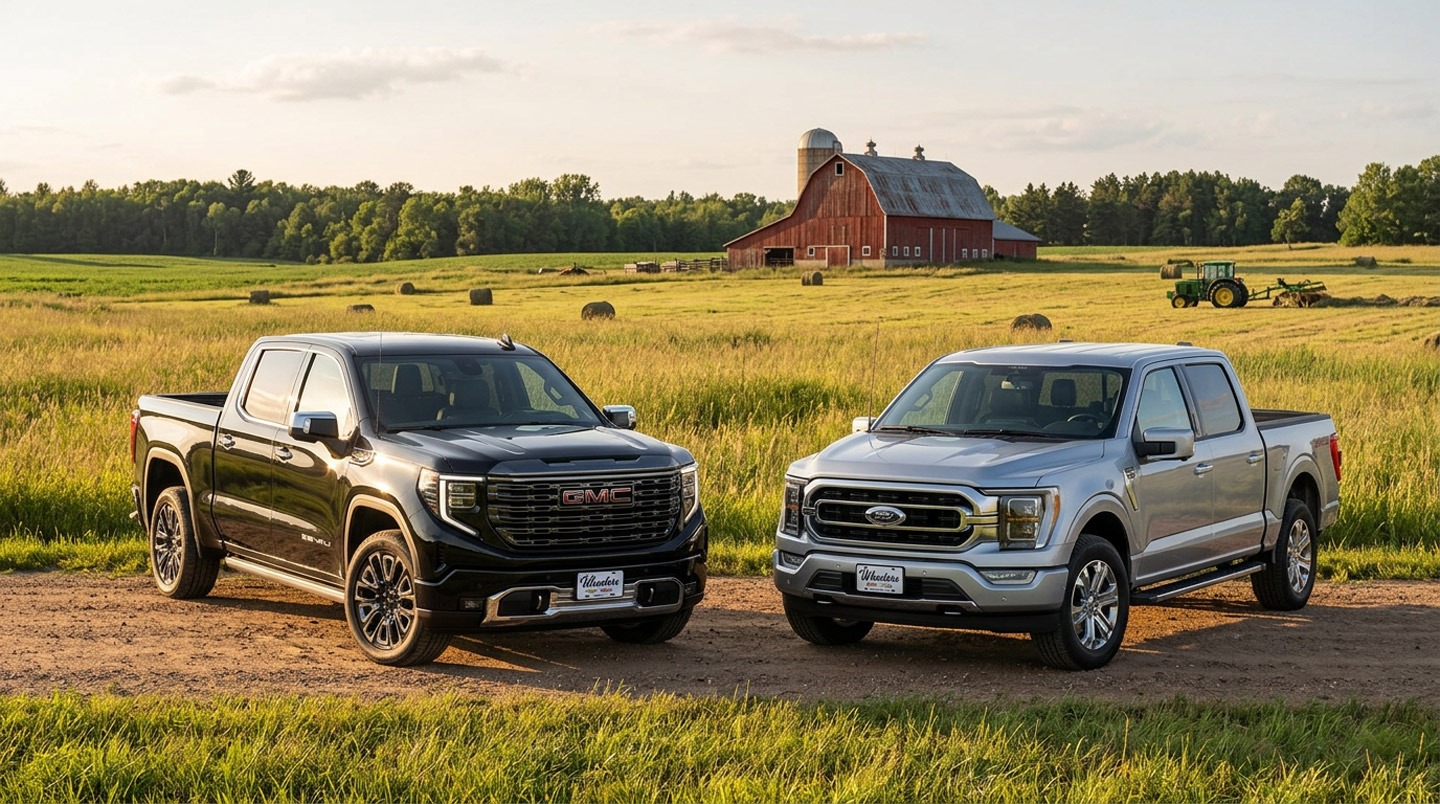
2026 GMC Sierra 1500 vs Ford F-150: Which Truck Wins for Wisconsin Buyers?
The GMC Sierra 1500 vs Ford F-150 debate is the most common comparison in the full-size truck segment — and for good reason. Both are excellent trucks. Both tow over 13,000 lbs. Both offer luxury trims that push into $80,000 territory. Both have been refined over decades of real-world truck use. The question isn't which one is good. The question is which one is right for how you actually use a truck in Wisconsin Rapids, Wausau, Stevens Point, and across Central Wisconsin.
This comparison is written from a GMC dealer's perspective — so yes, we believe the Sierra makes the stronger case for most buyers in our market. But we're also going to tell you exactly where the F-150 wins, because our job is to help you make the right decision, not to oversell a truck that's not the right fit for you. If the F-150 is genuinely better for your use case, you'll find that here.
How these two trucks actually compare
The Sierra 1500 and F-150 are more similar than they are different. They share the same platform category, similar pricing, comparable towing and payload ratings, and the same target buyer. Where they diverge is in how they deliver on the basics — and those differences show up in daily use.
A few things to understand before diving in:
- Both are legitimate work trucks and daily drivers. Neither is a compromise. The choice comes down to which strengths matter more in your specific situation.
- The F-150 outsells the Sierra nationally. That's brand loyalty and distribution, not an objective measure of quality. The Sierra consistently scores comparably or better in head-to-head reviews.
- Maximum towing specs are often misleading. The 200 lb difference between Sierra's 13,300 and F-150's 13,500 lbs maximum tow ratings requires specific configurations on both trucks and is not a meaningful real-world difference.
- Technology is where the gap is most visible. Google built-in on the Sierra vs. SYNC 4 on the F-150 is a genuine, daily-use difference that many buyers underestimate before they experience it.
At-a-glance specs comparison
| Spec | 2026 Sierra 1500 | 2026 Ford F-150 |
|---|---|---|
| Starting MSRP | Starting at $38,300 | Starting at $40,085 |
| Max towing | 13,300 lbs | 13,500 lbs |
| Max payload | 2,210 lbs | 2,440 lbs |
| Trim levels | 8 (Pro through Denali Ultimate) | 8 (XL through Raptor) |
| Engine options | 4 (TurboMax, Diesel, 5.3L V8, 6.2L V8) | 6 (2.7L, 5.0L V8, 3.5L EcoBoost, PowerBoost Hybrid, H.O. 3.5L, 5.2L SC) |
| Diesel option | Yes — 3.0L Duramax | No — discontinued after 2023 |
| Infotainment | Google built-in (native) | SYNC 4 (CarPlay/Android Auto) |
| Hands-free driving | Super Cruise (supports trailering) | BlueCruise (no trailering) |
| Standard screen size | 8" (Pro), 13.4" (SLE+) | 12" standard across lineup |
| Luxury top trim | Denali Ultimate | Platinum / King Ranch |
| Tailgate system | MultiPro tailgate (6 positions) | Pro Access Gate (center-open) |
| Off-road trim | AT4 / AT4X | Tremor / Raptor |
| Onboard power | No | Pro Power Onboard (hybrid models) |
| Hybrid option | No | PowerBoost — 430 hp, 578 lb-ft |
| Crew Cab availability | All 8 trims | All trims |
Specs represent standard/maximum configurations. Both trucks require specific packages for maximum towing ratings. Pricing excludes destination, taxes, title, and dealer fees.
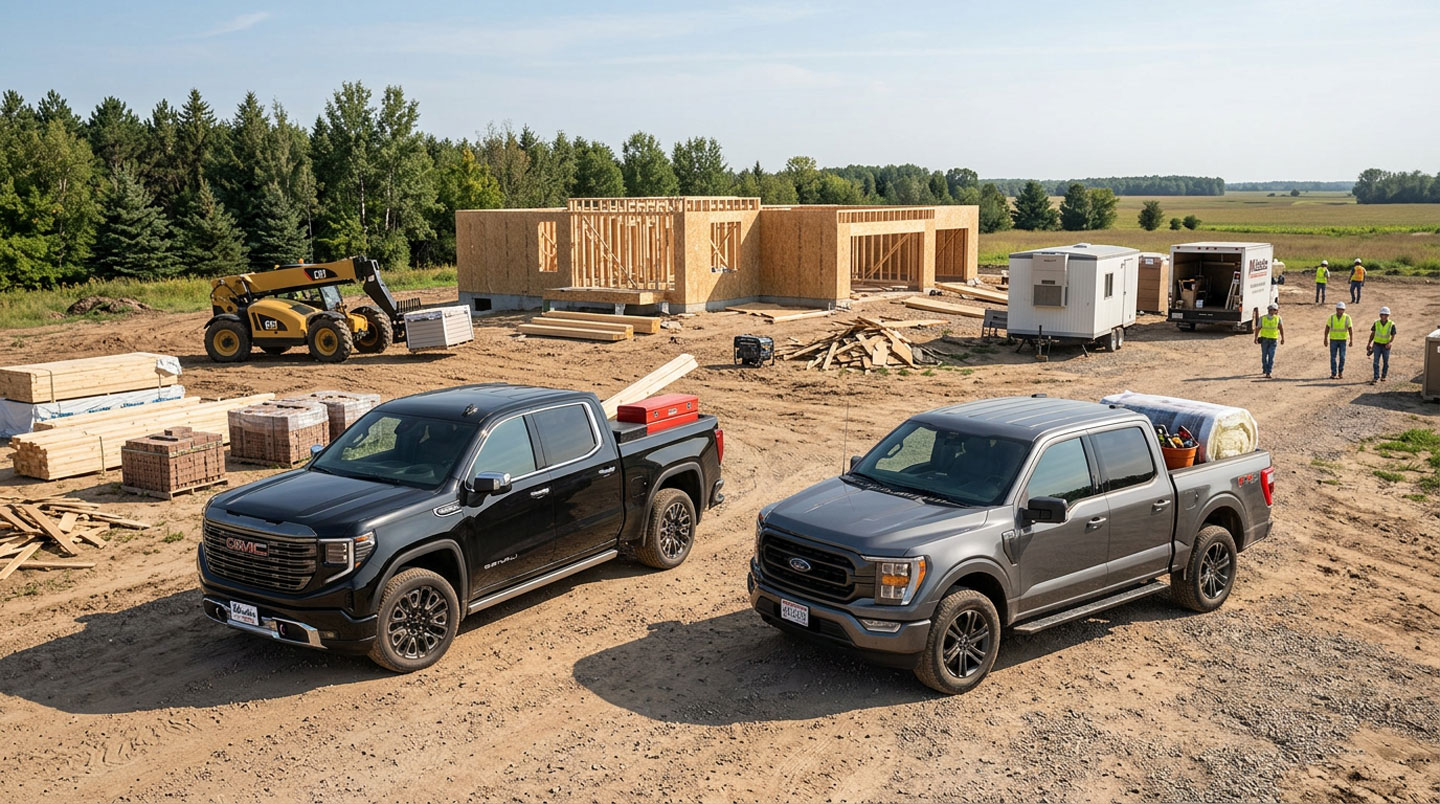
Where the Sierra 1500 wins
- Google built-in infotainment — native Google Maps, Google Assistant, and Google Play Store; not mirrored from your phone
- Diesel engine available — the 3.0L Duramax Turbo-Diesel delivers 495 lb-ft of torque and best-in-class highway fuel economy; Ford dropped its diesel after 2023
- Super Cruise with trailering support — the only hands-free system that stays active while towing; F-150's BlueCruise does not support trailering
- Denali luxury tier — the Denali and Denali Ultimate set a higher interior standard than the F-150 Platinum and King Ranch at comparable price points
- MultiPro tailgate — six functional positions including a work surface and inner gate; the F-150's Pro Access Gate is useful but less versatile
- Lower starting price — Sierra starts at $38,300 vs F-150's $40,085
- Wisconsin Rapids dealer support — Wisconsin Rapids GMC is your local dedicated service and sales resource; no Ford dealer in the immediate market
Google built-in — the daily driver difference
This is the Sierra's most underrated advantage and the one that makes the biggest daily-use difference. On the Sierra's 13.4-inch infotainment system at SLE and above, Google Maps is the native navigation app — not a mirrored version from your phone. Your Google account loads directly into the truck. Your saved places, recent searches, contacts, and preferences are there without plugging anything in.
Google Assistant responds to natural-language voice commands across the entire system — navigation, media, climate, vehicle settings. On the F-150 with SYNC 4, voice commands work through the phone's assistant via CarPlay or Android Auto, which means your phone has to be connected and the system has to hand off between interfaces. It's capable. It's just not as seamless.
For buyers who use their truck as a daily driver in and around Wisconsin Rapids, Wausau, and Stevens Point — running navigation, making calls, managing music, and asking questions while driving — Google built-in is a genuine quality-of-life improvement.
Diesel — Sierra's exclusive edge
Ford discontinued its 3.0L Power Stroke diesel in the F-150 after the 2023 model year. The Sierra's 3.0L Duramax Turbo-Diesel remains available, delivering 305 hp and 495 lb-ft of torque with the best highway fuel economy in the half-ton segment. For buyers who put significant highway miles on the truck — long runs between Wisconsin Rapids and Milwaukee, regular interstate travel, or frequent towing over long distances — the diesel's efficiency makes a real financial case. The F-150's PowerBoost hybrid is an alternative efficiency play, but it's a fundamentally different technology with different ownership characteristics.
Super Cruise vs BlueCruise — the trailering gap
Both Sierra and F-150 offer hands-free driver assistance systems. The critical difference: Super Cruise on the Sierra remains active while trailering. BlueCruise on the F-150 does not. For Wisconsin buyers who regularly tow — a boat on the Wisconsin River, a camper to Northwoods lake cabins, farm equipment between properties, or deer camp gear through the fall — Super Cruise's trailering capability is a real-world advantage that shows up every time you hook something up and get on the highway.
Where the F-150 wins
- Maximum towing edge — 13,500 lbs vs Sierra's 13,300 lbs; a 200 lb advantage at the top end
- Higher payload capacity — 2,440 lbs vs Sierra's 2,210 lbs; meaningful for buyers who haul heavy loads in the bed
- More engine options — six powertrains including the PowerBoost hybrid; Sierra offers four
- PowerBoost hybrid with Pro Power Onboard — up to 7.2 kW of exportable electrical power from the bed; runs tools, charges devices, powers a job site; Sierra has no equivalent
- 12-inch screen standard across the lineup — the F-150 XL starts with a 12-inch SYNC 4 screen; Sierra Pro starts with 8 inches
- BlueCruise now available on more trims — available on Lariat, King Ranch, Platinum, and Tremor; Super Cruise on Sierra is limited to Denali and Denali Ultimate
- Raptor off-road performance — no Sierra equivalent matches the Raptor's high-speed desert-running capability
Pro Power Onboard — F-150's biggest unique advantage
This is the feature with no Sierra equivalent and the one most likely to be the deciding factor for a specific type of buyer. The F-150 PowerBoost hybrid can export up to 7.2 kW of electrical power from the truck bed — enough to run power tools, charge equipment, power a construction site without a generator, or keep a remote cabin or deer camp running on grid-free power. For contractors, tradespeople, and serious outdoor enthusiasts who regularly work in locations without power access, Pro Power Onboard is a genuine productivity tool. If this describes your use case, the F-150 deserves a serious look.
Payload advantage — who it actually matters for
The F-150's 2,440 lb payload vs Sierra's 2,210 lb payload is a 230 lb advantage. In practical terms, this matters for buyers who regularly load the bed to its limit — heavy landscaping materials, wet lumber, or multiple passengers plus cargo. For most Wisconsin buyers using the truck as a daily driver with occasional bed loads, neither truck will approach its payload limit in normal use. If you're loading consistently heavy, weigh your options carefully.
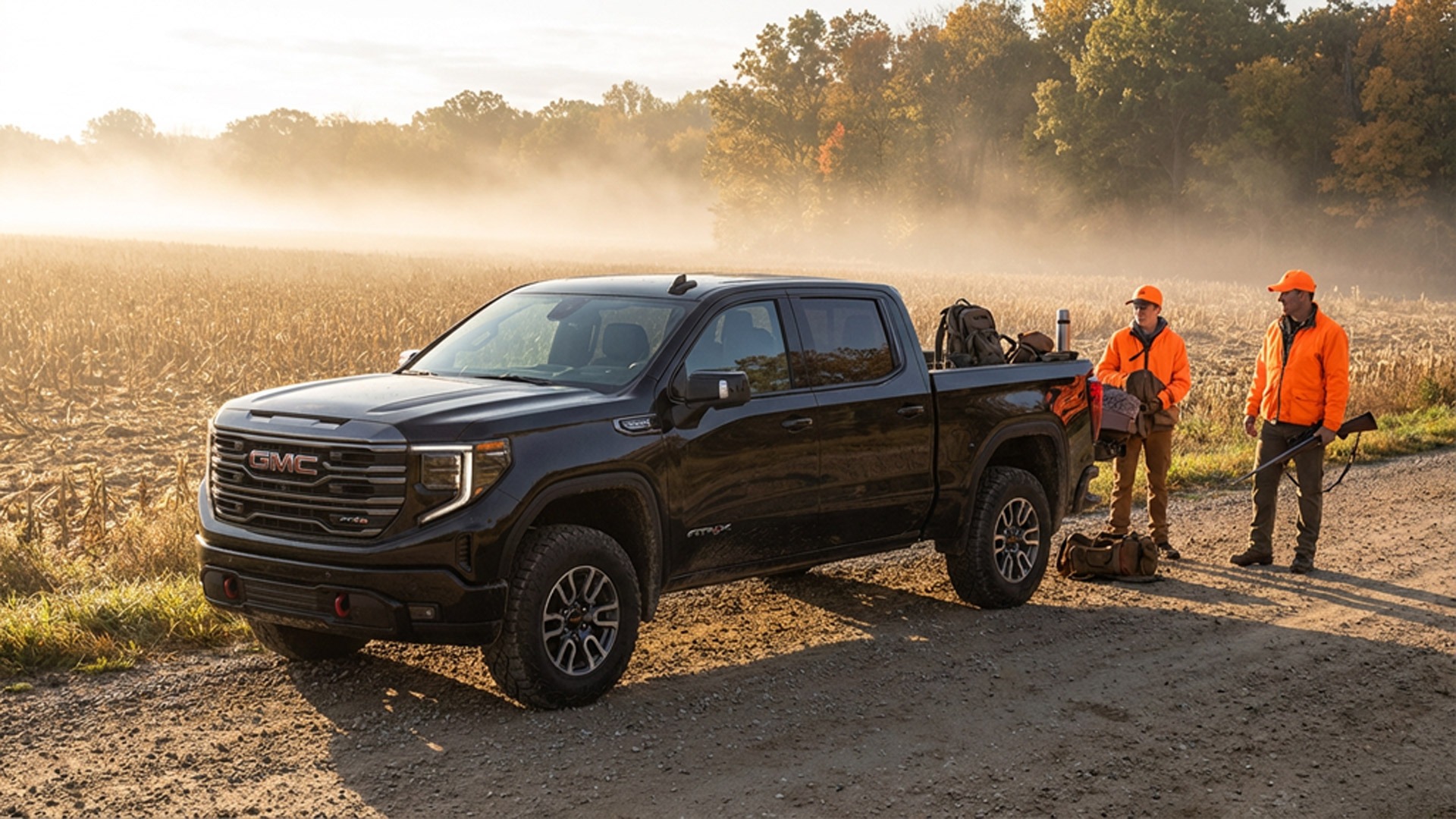
Towing comparison — the honest breakdown
Maximum towing specs get a lot of attention in truck comparisons, and the numbers can be misleading. Here's a grounded look at how these two trucks compare for the towing that actually happens in Central Wisconsin.
| Towing Scenario | Sierra 1500 | F-150 |
|---|---|---|
| Average pontoon boat (5,000–8,000 lbs) | Either engine handles it | Either engine handles it |
| Large camper / fifth wheel (10,000–12,000 lbs) | 5.3L V8 or 6.2L V8 | 3.5L EcoBoost or PowerBoost |
| Maximum trailer load (13,000+ lbs) | 6.2L V8 or Duramax — 13,300 lbs | 3.5L EcoBoost — 13,500 lbs |
| Long-distance towing efficiency | Duramax diesel — best highway MPG | PowerBoost hybrid — strong efficiency |
| Hands-free while towing | Super Cruise — active while trailering | BlueCruise — disabled while towing |
| Camera views for hitching | Up to 14 camera views | Multiple camera views |
| Integrated trailer management | ProGrade Trailering System | Ford Trailer Tow package |
The practical takeaway: for Wisconsin buyers towing boats on Lake Petenwell, pontoons on the Wisconsin River, campers to Northwoods destinations, or farm and utility equipment around Wood and Portage counties, both trucks do the job comfortably. The F-150's 200 lb towing advantage at the maximum end never comes into play for the vast majority of loads. The Sierra's diesel efficiency advantage and Super Cruise trailering support are meaningful on longer hauls.
Technology comparison
Technology has become the most significant differentiator between these two trucks in daily use. Here's how the key systems compare.
Infotainment — Google vs SYNC 4
The Sierra's Google built-in system and the F-150's SYNC 4 are both capable, modern infotainment platforms. The difference is in how they work day-to-day. Google built-in on the Sierra works like a native Android device built into the dash — your Google account, Google Maps, Google Assistant, and Play Store apps are there regardless of whether your phone is in the truck. SYNC 4 on the F-150 is a well-designed system that integrates tightly with Apple CarPlay and Android Auto, but those systems depend on your phone connection. If you want seamless integration without thinking about it, Sierra's approach wins. If you prefer your phone to be the center of your digital experience, SYNC 4 handles that well.
Hands-free driving — Super Cruise vs BlueCruise
Super Cruise uses LiDAR-mapped highway data plus a driver attention camera to enable truly hands-free driving on compatible divided highways — which includes most of Wisconsin's interstate system. It's available on the Sierra Denali and standard on the Denali Ultimate. BlueCruise on the F-150 uses similar technology and works on comparable roads — it's available on the Lariat and above, making it accessible at a lower trim level than Super Cruise. The Sierra's advantage is trailering support. The F-150's advantage is broader trim availability. For most buyers not specifically cross-shopping Denali territory, BlueCruise's trim availability is the more practical consideration.
Tailgate — MultiPro vs Pro Access
The Sierra's MultiPro tailgate offers six distinct positions: load stop, EZ lower, work surface, inner gate (which drops down to create a smaller secondary gate), step function, and full open. The inner gate and work surface modes are genuinely useful for loading and managing cargo. The F-150's Pro Access Gate opens from the center outward, providing easy access to the full bed width from the side — useful for loading wide items or setting things on the tailgate from the side. Both are real improvements over a standard tailgate. The MultiPro's versatility is broader; the Pro Access's center-open design is intuitive for specific use cases.
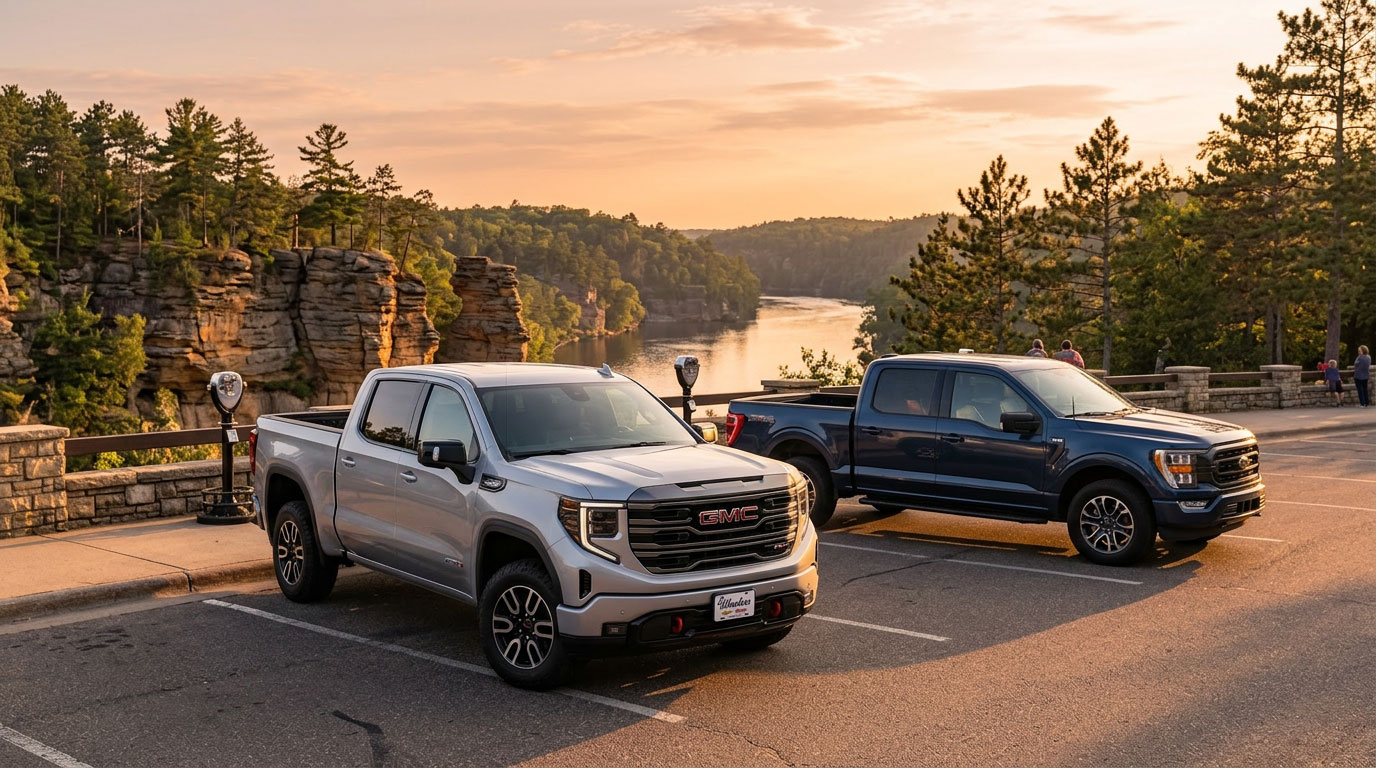
Pricing comparison
| Trim Tier | Sierra 1500 | F-150 Equivalent |
|---|---|---|
| Entry / Work | Pro — starting at $38,300 | XL — starting at $40,085 |
| Mid / Value | SLE — starting at $48,700 | XLT — starting at $48,490 |
| Premium mid | SLT — starting at $55,000 | Lariat — starting at $62,355 |
| Off-road | AT4 — starting at $60,000 | Tremor — comparable pricing |
| Luxury | Denali — starting at $67,000 | King Ranch — starting at $68,620 |
| Top luxury | Denali Ultimate — starting at $80,000 | Platinum — starting at $71,595 |
Pricing approximate for Crew Cab 4WD configurations. Excludes destination, taxes, title, and dealer fees. Both truck prices vary significantly by configuration and options.
The Sierra has a meaningful price advantage at the entry level and a strong value proposition in the SLT vs Lariat comparison — the Sierra SLT starts around $7,000 below an equivalent F-150 Lariat at the same approximate feature level. At the luxury tier, the Denali Ultimate pushes above the F-150 Platinum's starting price, reflecting its more exclusive positioning.
For current Sierra 1500 pricing and available incentives at Wisconsin Rapids GMC, request a quote or browse current inventory.
Our verdict for Central Wisconsin buyers
Sierra 1500 vs F-150 — the bottom line
- Choose the Sierra 1500 if: Google built-in matters to you as a daily driver, you want a diesel option for long-distance efficiency, you tow regularly and want hands-free driving that stays active while trailering, you want the Denali luxury tier, or you value the MultiPro tailgate's versatility for work use.
- Choose the F-150 if: Pro Power Onboard is a genuine need for your job or outdoor use, you specifically want the PowerBoost hybrid's combination of power and efficiency, payload capacity is a regular concern over 2,200 lbs, or you want BlueCruise hands-free driving available at a lower trim level than Denali.
- Don't choose either truck based on maximum towing specs. The 200 lb difference between 13,500 and 13,300 lbs is not a real-world factor for any towing scenario that Wisconsin buyers encounter regularly. Build your decision around the features you'll actually use every day.
- The local advantage matters. Wisconsin Rapids GMC is your Central Wisconsin GMC dealer — service, support, warranty work, and the buying relationship are all here, 30 minutes from Stevens Point and 45 minutes from Wausau. That's a real consideration when your truck needs attention at 7am before a job starts.
For the full Sierra 1500 model overview, see the 2026 GMC Sierra 1500 complete model guide. For a full trim breakdown, see the Sierra 1500 trim levels guide.
Ready to See the Sierra 1500 in Person?
Wisconsin Rapids GMC — serving Wisconsin Rapids, Wausau, Stevens Point, Marshfield, and all of Central Wisconsin.
Frequently asked questions — Sierra 1500 vs F-150
Is the GMC Sierra 1500 better than the Ford F-150?
It depends on your priorities. The Sierra 1500 wins on interior refinement, Google-native infotainment, the MultiPro tailgate, diesel availability, and the Denali luxury tier. The F-150 wins on maximum towing capacity (13,500 lbs vs 13,300 lbs), payload capacity (2,440 lbs vs 2,210 lbs), and more engine variety including the PowerBoost hybrid with Pro Power Onboard. For most Central Wisconsin buyers who prioritize daily usability and technology, the Sierra makes the stronger case.
How does Sierra 1500 towing compare to the F-150?
The 2026 Ford F-150 has a slight maximum towing advantage at 13,500 lbs with the 3.5L EcoBoost V6, compared to the Sierra 1500's 13,300 lbs with the 6.2L V8 or Duramax diesel. In real-world use, 200 lbs is not a meaningful difference. Both trucks handle the vast majority of Wisconsin towing needs — boats, campers, farm equipment, and utility trailers — with equal capability. The Sierra has an advantage in diesel efficiency for long-distance towing and in Super Cruise trailering support.
Does the GMC Sierra have better technology than the F-150?
The Sierra 1500 has Google built-in as a native system at SLE and above — Google Maps, Google Assistant, and the Google Play Store are integrated directly, not mirrored from your phone. The F-150 uses SYNC 4 with Apple CarPlay and Android Auto integration. The Sierra's Google system is a genuine daily-use advantage for buyers who use navigation, voice commands, and app-based connectivity regularly. The F-150 has an advantage with Pro Power Onboard on hybrid models for exportable electrical power.
Is the GMC Sierra MultiPro tailgate better than the F-150 Pro Access Gate?
The Sierra MultiPro tailgate offers 6 configurations — load stop, EZ lower, work surface, inner gate, step, and full open — making it one of the most versatile tailgate systems available. The F-150 Pro Access Gate opens from the center and provides convenient side access to the bed. Both are genuinely useful improvements over a standard tailgate. The MultiPro offers more functional versatility for work-focused buyers; the Pro Access Gate's center-open design is intuitive for specific loading scenarios.
Where can I test drive a GMC Sierra 1500 near Wausau or Stevens Point?
Wisconsin Rapids GMC at 2410 W Grand Ave, Wisconsin Rapids, WI is the area's dedicated GMC dealer serving Wisconsin Rapids, Wausau, Stevens Point, Marshfield, and surrounding Central Wisconsin communities. Wisconsin Rapids is approximately 45 minutes from Wausau and 30 minutes from Stevens Point via US-51. Browse current Sierra 1500 inventory online or contact us to schedule a test drive.